MWBC Crop Conditions: Uncertainty
According to NASS: Warm temperatures, high winds and minimal moisture were observed across Montana last week, according to the Mountain Regional Field Office of the National Agricultural Statistics Service, USDA. Reporters across the state noted grasshopper activity has been abundant with the hot and dry conditions. Topsoil moisture conditions were 43 percent adequate to surplus, compared to 81 percent last year. Subsoil moisture conditions were 46 percent adequate to surplus. Barley booted was estimated at 36 percent, behind the 5-year average of 43 percent. Corn emerged is estimated at 74 percent complete, slightly behind the previous year at 79 percent. Dry edible peas emerged is estimated at 91 percent complete, slightly behind the previous year and 5-year average of 94 percent. Oilseed emergence is progressing well, with an estimated 82 percent of both flaxseed and mustard seed crop emerged. Safflower emerged is estimated at 51 percent complete, equal to the 5-year average. Oats emerged is estimated at 96 percent complete, ahead of the previous year at 94 percent and the 5-year average of 89 percent. Sugarbeets emerged was estimated at 96 percent, slightly behind the previous year at 97 percent. Spring wheat booted is estimated at 33 percent complete, ahead of the previous year at 31 percent, but behind the 5-year average of 39 percent. Winter wheat was reported with 82 percent of the crop booted, slightly ahead of the previous year at 81 percent. Winter wheat conditions were rated as 43 percent good to excellent, compared to 85 percent this time last year.
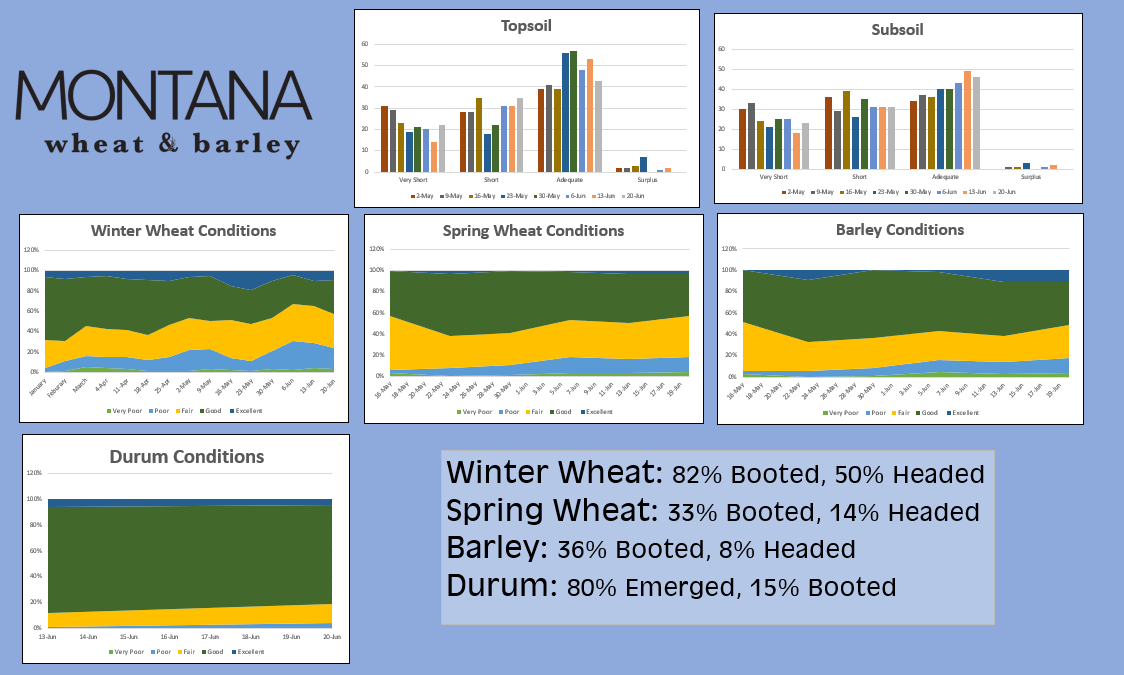
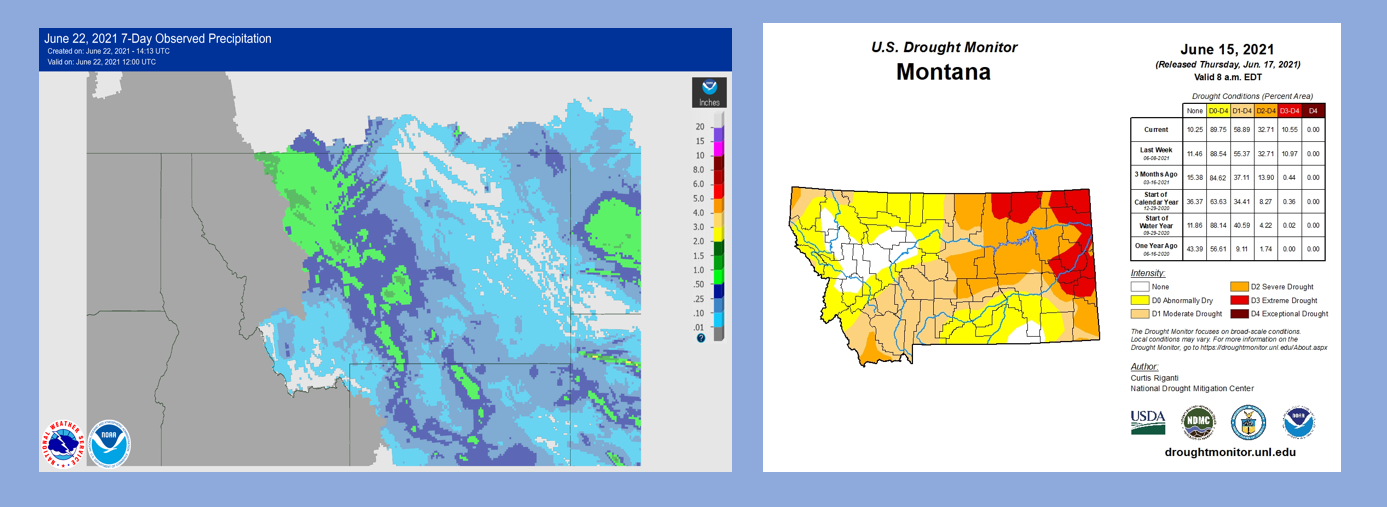
Winter wheat conditions improved while barley, durum and spring wheat did not. Perceptions of the crop conditions can change depending on your baseline of what a good crop looks like, so the changes may be a correction. Moisture conditions digressed as last week’s July like conditions evaporated topsoil moisture, it felt like Arizona more than Montana last week. The last 7 days saw minimal moisture events with the golden triangle area seeing around .5 inch.
Comments on conditions are of concern:
- Grasshoppers are in full swing hearing the highest populations in the Fort Benton area
- Cutting and bailing hay is at a critical point, get it stored and away, you will have no problem finding a buyer
- Crops are short; the heat appears to stress the plant to produce seed without normal canopy
- Tillers are not surviving
In the words of Michele Jones:
“It’s dry
🔥
🔥
Really dry.
🔥
🔥
Scary dry actually.
🔥
🔥
We’ve been on trending drier since November. But the killer has been very very dry April, May and June. Months we typically get half of our annual moisture.
🔥
🔥
It’s also been insanely hot in June. Record torching hot. Nearly 110 early last week. Normal is not even 80 in late June. 🔥🔥
🔥
The winter wheat is showing the stress. It’s short - not even knee high. And burning off bottom leaves at an alarming rate. It’s a blue cast - which is never good - and while the heads are actually good sized, they won’t fill with grain without rain.
🔥
🔥
And the winter wheat is actually holding on the best. The hay crop is failed - it’s a disaster. Corn has failed, barley is failing and safflower barely hanging on.
🔥
🔥
This year is crushing producers on the Northern Plains and Canadian Prairies …
🔥
🔥
And we won’t even talk about why our area is only in D1 drought on the Drought Monitor - believe me when I say it should be D2 or D3.”
View this post on Instagram
Looking on the bright side Jeremy Grove is optimistic:
"March was cold, April caught some interesting moisture at times, We're still hopeful for rain, overall good stand on the crops. Cross our fingers we do not have a grasshopper problem" Jeremy Grove's mid-season optimism is admirable, as threats to production linger, uncertainty is still at the forefront of every producer's mind.
Changing thoughts on the KCS, CN or CP merger:
U.S Wheat associates transportation working group has been closely monitoring the progress of the merger. Getting back to the basics of economic theory does not apply to the rail lines in the U.S with only 7 class 1 rail lines. Each line has their market that slightly competes. Consolidation is debatable as a good thing for shippers and producers. Government regulation on freight rates makes minimal progress in the U.S. In Montana, the BNSF will be the main/only source of shipping for the foreseeable future. Their operational efficiency program does a great job of getting our grain out of the state in a short turn around. This potential merger could provide a blueprint for continued mergers which could impact Montana. MWBC is a voting representative on U.S wheat associates transportation group and will represent our state well. Send us your thoughts/comments to WBC@mt.gov
Field days are back on! Look at the schedule CLICK HERE
If you need help sourcing wheat and barley ingredients for your business, we would love to help. We will connect you with several options that provide numerous methods of delivery. All our wheat and barley suppliers can conduct negotiations virtually to fit your country or states regulations if needed, otherwise social distancing is not a problem out here
Tags: